
There's a moment that repeats itself so often here that we've stopped being surprised by it. Somewhere around the third or fourth morning, a guest will come down to breakfast and mention — almost in passing, the way you'd mention the weather — that they slept. Not "slept well." Just slept. Straight through, for the …

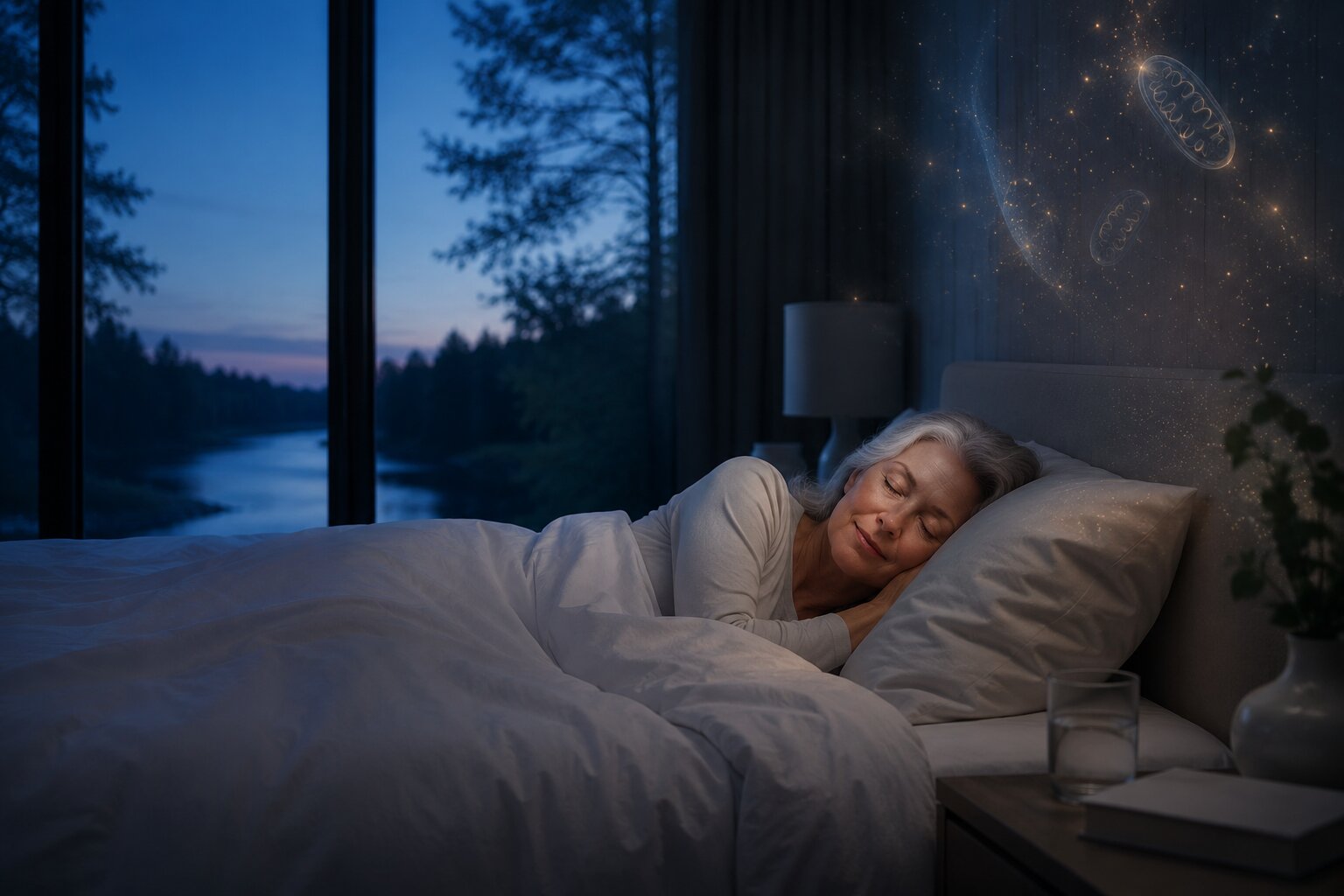
There’s a moment that repeats itself so often here that we’ve stopped being surprised by it. Somewhere around the third or fourth morning, a guest will come down to breakfast and mention — almost in passing, the way you’d mention the weather — that they slept. Not “slept well.” Just slept. Straight through, for the first time in longer than they can say. They usually report it like it happened to somebody else.
It comes up more than almost anything else during a week with us. More than the food. More than the therapies. And for a long time we filed it under the obvious explanation: people are away from home, the pace is slower, the phone isn’t ringing. Of course they sleep.
That explanation isn’t wrong. It’s just smaller than what’s actually going on.
Melatonin does more than turn out the lights
Most of us learned to think of melatonin as the sleep hormone. The thing the body releases when it gets dark. The thing sold in a bottle at the pharmacy for people who can’t drop off. All true, as far as it goes.
What the research has been steadily filling in is that melatonin is also one of the body’s more capable housekeepers. It concentrates inside the parts of the cell where the day’s ordinary wear collects — particularly the mitochondria, the small structures where energy gets made and where, as a byproduct of making it, damage accumulates. Melatonin is one of the few molecules that gathers precisely in that high-traffic zone. It neutralizes the reactive compounds that build up through the day, and it supports the repair processes that run overnight.
This isn’t a figure of speech about beauty sleep. It’s a real, nightly process. Melatonin is a meaningful part of what powers it.
Two things worth knowing once you’re past forty
The first is that the body makes less of it as the years go on. Production begins to taper somewhere in our thirties and keeps tapering as the pineal gland gradually changes. That’s not cause for alarm — it’s simply true, and worth knowing, because it means the overnight repair window may be running on less fuel than it used to.
The second is that quite ordinary evening habits thin out what’s left. A bedroom that stays warm through the night. A late supper the body is still working through at bedtime. A room that never really goes fully dark — a hallway light, a streetlamp coming through thin curtains, the small steady glow of something charging on the nightstand.
Most of us have treated those as sleep-quality questions. Whether we’ll fall asleep. Whether we’ll stay asleep. They appear to be repair questions as well.
What actually changes during a week here
This is the point where people expect us to hand them a protocol, and we don’t have one.
What a week here does to a person’s sleep is mostly a matter of conditions rather than instruction. Supper comes earlier than most people are used to. The evening is long and there isn’t much on the schedule. The rooms get genuinely cool at night, and genuinely dark once you turn in. And morning arrives with real daylight — people are outside early, walking down toward the river, and that morning light is what sets the clock governing the evening release in the first place.
None of that is a technique. It’s a set of circumstances. The body responds to it without being told to.
We’ll sometimes mention walnuts, which happen to be one of the few foods carrying a little melatonin of their own — a small handful in the evening. But that’s a footnote, not a program. The larger point is the one we come back to constantly: the body already knows how to do this. What it needs is conditions, not correction.
Taking it home
The question guests ask most is what to do when the week ends and ordinary life resumes. The warm house. The late dinners. The ambient light of a normal bedroom on a normal street.
Our honest answer is that you don’t need to reproduce the retreat. You need to protect the window.
A bedroom cooler than feels natural at first. Curtains that genuinely block the streetlight, or an eye mask if that’s simpler. Supper early enough that digestion isn’t still underway when you lie down. And morning light on your face within the first hour of waking — a few minutes outside before anything else, which does more for the following night than most things you could do in the evening.
Small, unglamorous adjustments. That’s usually how this goes.
The part we keep coming back to
We’ve never thought of the body’s capacity for repair as separate from the way it was made. It’s of a piece with everything else we teach here — that the design is sound, that it’s still working, and that most of our job is removing what interferes with it rather than adding something clever.
There’s something quietly reassuring in the fact that the most restorative work of your day happens while you are doing nothing at all. It doesn’t depend on your effort, or your discipline, or how well you performed today. It was arranged to run on its own.
You just have to let the dark come.
Questions We Hear Most Often
Why do I sleep so much better away from home than in my own bed?
Because sleep responds more to conditions than to effort. Away from home you often eat earlier, sit in dimmer light through the evening, and end up in a cooler, darker room than you keep at home. Those three things — timing, light, and temperature — shape how much melatonin the body releases and when. It usually isn’t the bed. It’s the circumstances around it.
Is it normal to sleep worse as you get older?
It’s very common, and part of it is simply that melatonin production tapers with age, beginning somewhere in our thirties. But it’s worth knowing that the ordinary conditions of an evening also affect what’s left — a warm bedroom, a late meal, a room that never goes fully dark. Age is a real factor. It isn’t the only one, and the others are adjustable.
How cool and how dark should a bedroom actually be?
Cooler and darker than most people keep it. Melatonin peaks alongside the drop in core body temperature that happens overnight, so a warm room blunts that peak. As for darkness, the body is sensitive to surprisingly small amounts of light — a hallway light under the door or a streetlamp through thin curtains registers. Blackout curtains or a simple eye mask are usually enough.
Does morning sunlight really affect how you sleep that night?
Yes, and it’s one of the more useful things to know. Light in the first hour after waking sets the internal clock that governs when melatonin is released in the evening. A few minutes outside in the morning often does more for that night’s sleep than anything you’d do at bedtime.
Are there foods that contain melatonin?
A few do. Walnuts are the best known — a small handful in the evening is a reasonable habit. Tart cherries and some seeds carry modest amounts as well. These are a supporting detail rather than a strategy; the conditions of your evening matter considerably more than any single food.
Is melatonin only about sleep?
No. Alongside signaling that it’s dark, melatonin acts as a potent antioxidant that concentrates inside cells — particularly in the mitochondria, where the day’s oxidative wear accumulates — and supports the repair processes that run overnight. That’s why the quality of your night matters beyond simply feeling rested the next day.
Our last retreat weeks of the year are October 11–16, 18–23, and 25–30, along the Etowah River near Kingston, Georgia. If a guided reset has been on your heart, you’re welcome to look at what a week could hold: HealthRetreat.com
This article is educational and is not medical advice. Nothing here is intended to diagnose, treat, cure, or prevent any condition, and no one should change or stop a prescribed medication without speaking to their own physician. Individual experiences vary.
We offer these teachings freely to support clarity, stewardship, and responsible care. If this article was helpful, you may explore additional resources here:
- MyHDiet.com — plant-based nutrition, enzymes, detox foundations
- WipeOutToxins.com — toxin-free living and prevention
- CleanseYourBlood.com — circulation and blood-flow support
- HealthRetreat.com — Hallelujah Health Retreats
- AMPMForHealth.com — everyday wellness rhythms and curated tools
Thank you for being part of a community committed to thoughtful, responsible healing.
Sources consulted:
Bhatti et al., Occupational & Environmental Medicine (BC Cancer Research Institute / UBC / SFU / Duke), on melatonin and DNA repair biomarkers.
Melatonin’s neuroprotective role in mitochondria, Translational Psychiatry, 2021.
Mitochondria: Central Organelles for Melatonin’s Antioxidant and Anti-Aging Actions, PMC, 2018.
Rhythms of life: melatonin, nutrition, sleep, and antioxidant strategies for healthy aging,” Frontiers in Neuroscience, 2026.
Melatonin as Anti-Aging Therapy, Frontiers in Aging Neuroscience, 2022.
Book a Consultation
It’s easy and free!